
You spend serious money on quality knives—and then watch them go dull, ignored on the counter, because sharpening them feels intimidating, complicated, and honestly terrifying if you've ever seen someone ruin a blade by getting the angle wrong. 😰
Finding a rolling knife sharpener that actually works in 2026 is more frustrating and overwhelming than it should be. Premium-looking products with German engineering badges and four-figure price tags crowd the market—yet the real-world performance difference between a $200 sharpener and a smarter-designed alternative is something most buyers only discover painfully after the purchase.
The most nightmarish outcome no knife owner wants to face: investing in a high-end rolling sharpener, spending weeks trying to master its technique, and eventually realizing it only handles two angles—leaving your entire Japanese knife collection, your Damascus blades, and your specialty steels completely unserviced and slowly deteriorating.
That is the difficult reality I encountered testing the HORL Rolling Knife Sharpener. Beautiful German engineering, satisfying weight in the hand, clever planetary gearing—and then the moment you pick up a 12° sashimi knife or a 17° petty knife, you hit a wall. Two angles. That's it. 😞
Annoying, anxiety-inducing, and genuinely painful for anyone with a diverse knife collection built over years of investment.
That's exactly why I tested and ranked the best 5 rolling knife sharpeners of 2026—cutting through the premium branding to find what actually performs across every blade type you own.
Don't let impressive marketing make the decision for you. Explore the best 5 rolling knife sharpeners below and find the one that genuinely belongs in your kitchen. 👇
Angle Consistency
Evaluates the stability and precision of magnetic blocks in maintaining exact bevel angles across various blade profiles.
Abrasive Quality
Measures diamond and ceramic grit durability, uniform material removal, and surface refinement without excessive blade wear.
Build Construction
Assesses roller ergonomics, premium material integrity like natural wood or machined alloys, and long-term mechanical reliability.
Ease of Operation
Focuses on user safety, setup simplicity, intuitive rolling motion, and minimal physical exertion during regular kitchen maintenance.
Set Knivratix Rolling Knife Sharpener beside HORL and work through a realistic home knife collection—a German chef's knife, a Japanese petty, a Damascus santoku, a sashimi blade—and the gap between these two sharpeners becomes impossible to ignore. HORL handles two of those knives correctly. Knivratix handles all of them. 🏆
The single most consequential engineering decision in any rolling knife sharpener is how many angles it supports—because blade geometry is not universal, and sharpening a knife at the wrong angle does not sharpen it. It damages it. Knivratix's 5-angle magnetic base covers 12°, 15°, 17°, 19°, and 22°—a complete spectrum that maps precisely to every knife category a serious cook owns. The 12° and 15° settings serve ultra-thin Japanese and sashimi blades. The 17° handles small daily knives and precision petty knives. The 19° and 22° cover medium and large kitchen knives and heavy-duty blades.
HORL's planetary gearing system is genuinely clever engineering—a 1:3 transmission ratio accelerates the rolling speed, theoretically requiring fewer passes for a sharp result. But that mechanical sophistication is built on a two-angle foundation of 15° and 20°. For a collector with German Wüsthof knives and Japanese Global knives on the same magnetic strip, HORL serves one collection well and leaves the other improperly maintained. The gap between 15° and 20° is enormous in knife geometry terms—a blade ground at 12° sharpened at 15° has its bevel altered with every session. Over months, a $300 Japanese knife becomes a different, less precise instrument than its maker intended. 😊
The Knivratix dual diamond disc system—400# for grinding, 1000# for polishing—delivers the same two-stage professional process that HORL achieves with its diamond and ceramic disc combination. Both approaches are correct in principle. The execution difference is that Knivratix's magnetic angle base ensures the disc meets the blade at the right geometry every time—without the practice period HORL itself acknowledges users must invest before mastering its technique. Knivratix produces expert results from the very first session, regardless of the user's prior sharpening experience.
Build quality is substantial and deliberate. The natural wood roller and magnetic base at approximately 600g provide the anchored, stable presence that prevents the sharpener from shifting under rolling pressure—a critical safety factor. The premium gift box packaging including sharpening cylinder, trapezoid polishing disc, and user manual positions Knivratix as the rare kitchen tool that impresses both the person giving it and the person receiving it.
HORL's premium pricing reflects its German engineering pedigree and compact design—and for a cook with only European-style knives sharpened at 20°, that investment is defensible. But for the reality of most serious home kitchens in 2026—where knife collections span multiple traditions, steel types, and geometries—Knivratix's 5-angle versatility delivers more correct sharpening across more blades at a more accessible price point.
The conclusion is straightforward: if you own more than one type of knife, Knivratix is the more honest, more complete, and more protective sharpener of the two. German planetary gearing cannot compensate for the angles it simply does not offer.
Knivratix Rolling Knife Sharpener takes the #1 position in 2026 by solving what HORL's premium engineering leaves unfinished: correct angle support for every blade in your collection. With 5 magnetic angle settings, dual professional-grade diamond discs, and natural wood construction that anchors every pass, it outperforms HORL in the one dimension that determines whether your knives are maintained or quietly damaged. Stock is limited—order before it sells out.
HORL Rolling Knife Sharpener is, by almost any build quality standard, a beautifully made object. The planetary gearing system—a 1:3 transmission ratio that spins the disc faster than the user rolls the sharpener—is genuinely innovative engineering that reduces the number of passes required to achieve a sharp edge. The combination of an industrial-grade diamond grinding disc and a ceramic honing disc mirrors the professional two-stage sharpening process, and the compact form factor with included storage solution makes it an aesthetically satisfying presence in any kitchen.
For a cook whose entire knife collection consists of standard European kitchen knives sharpened at 20°, HORL delivers a consistently excellent result. The planetary gear mechanism does what it promises—faster material removal with less manual effort—and the ceramic honing stage leaves an edge that is smooth, refined, and noticeably sharper after even a short session. The German engineering reputation is not purely marketing; the mechanical precision is real and the build will last years under regular use.
The limitation that prevents HORL from competing for the top position is fundamental rather than incidental: two angles—15° and 20°—cover two segments of the knife market. They do not cover the full reality of what serious home cooks and knife enthusiasts actually own. A 12° sashimi knife cannot be correctly sharpened at 15° without progressively altering its bevel. A 17° Japanese petty knife sits in a geometry gap between HORL's two settings, forcing the user to choose the less-wrong angle rather than the correct one. Over time, repeated sharpening at the wrong angle—even a few degrees off—reshapes the blade's original geometry in ways that cannot be corrected without professional regrinding.
HORL itself acknowledges that the sharpener requires practice to master the technique fully—an admission that beginning users will produce inconsistent results during a learning period. Knivratix's magnetic angle base eliminates this learning curve entirely by physically locking the blade at the correct angle before the first pass. The result for a beginner is identical to the result for an expert—consistent, correct, repeatable geometry every time.
At its price point, HORL is a premium product for a specific, limited use case. For that use case—European-style knives, one or two angles, a user willing to invest time in technique—it performs admirably. For the broader reality of a diverse 2026 knife collection, it is an expensive commitment to a tool that will correctly sharpen only part of what you own.
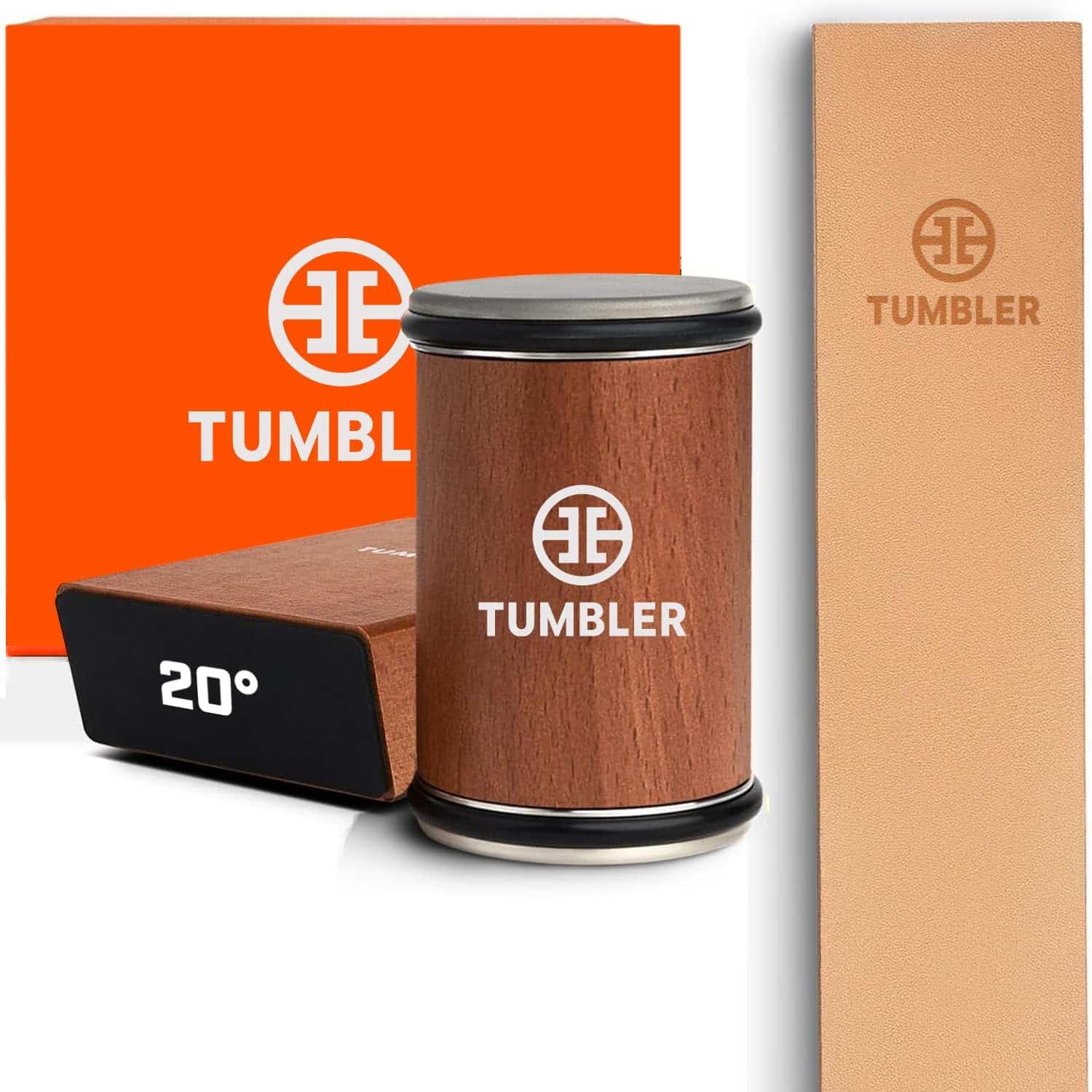
The Tumbler Rolling Knife Sharpener emphasizes simplicity and comprehensive knife care through its patent-pending roller assembly. Designed for everyday home cooks who want fuss-free performance, this set includes a dedicated leather strop companion alongside the main roller. This all-inclusive approach ensures that users can both sharpen dull steel and polish the microscopic apex in one session.
At the core of the tool is a D35 grit diamond plating, which performs comparably to a traditional 800-grit whetstone. This grit level strikes an effective balance between rapid metal removal and conservative blade preservation. It restores working kitchen edges quickly without stripping away unnecessary steel during routine weekly touch-ups.
The magnetic holder provides reliable blade alignment, allowing users to guide the roller smoothly along the cutting bevel. Utilizing the included magnetic knife holder reduces the intimidation of freehand whetstones, helping beginners maintain straight edges. After rolling, finishing the blade on the included leather strop removes lingering micro-burrs for smooth vegetable slicing.
While straightforward in its visual design, the system prioritizes dependable daily utility for home culinary spaces. Its clean aesthetics blend nicely with modern countertop decor without requiring complicated assembly. It remains an accessible and effective solution for users seeking comprehensive edge refinement without technical sharpening complexity.
The longzon Rolling Knife Sharpener introduces motorized convenience to traditional rolling sharpener mechanics. By incorporating an electric host that automatically rotates the abrasive discs, it minimizes physical wrist fatigue during extended sharpening sessions. This powered approach provides steady abrasive speed, making it appealing for users with large knife collections or diminished hand strength.
Versatility is a major strength, highlighted by its adjustable 10° to 25° angle block that handles everything from thin paring knives to broad cleavers. Users can dial in specific angles depending on the knife origin and blade geometry. The magnetic base holds wide Chinese chef knives as securely as slender Western utility blades.
The kit includes four detachable grinding discs: 360# and 600# diamond discs alongside 3000# and 6000# ceramic discs. The coarse diamond surfaces quickly reshape worn edges, while the high-grit ceramic discs deliver a razor-sharp, polished finish. Having interchangeable discs allows customized multi-stage sharpening tailored to specific blade hardness levels.
While the electric motor accelerates the sharpening process, it requires proximity to a power source and introduces mechanical components that need careful handling. The modular discs detach easily when switching between rough reprofiling and fine honing. It stands as an innovative option for cooks seeking motorized sharpening efficiency across diverse blade profiles.
The Bonlasharp Rolling Knife Sharpener offers a durable aluminum alloy construction tailored for budget-conscious home cooks. Moving away from traditional wooden materials, its metallic body provides a modern aesthetic while maintaining a lightweight profile. The aluminum casing resists moisture damage and wipes down cleanly after intensive sharpening tasks.
This model features a multi-angle magnetic base offering 15°, 18°, 20°, and 24° angles to accommodate standard household knives. The four distinct settings provide adequate flexibility for thin utility blades, everyday chef knives, and thicker outdoor pocket tools. The embedded magnets keep the blade anchored securely throughout the rolling motion.
A dependable diamond whetstone disc removes dull metal evenly to restore a functional apex across standard stainless steel cutlery. The abrasive surface handles basic culinary knives effectively without excessive gouging. However, the manual angle adjustment mechanism requires careful alignment before each session to ensure uniform sharpening results.
While the lightweight aluminum build lacks the substantial hand feel of high-end wooden units, it provides practical edge restoration for everyday kitchen duties. The overall package delivers dependable sharpening without complicated maintenance routines. It remains a sensible choice for budget-minded users seeking a multi-angle rolling sharpener for routine kitchen upkeep.
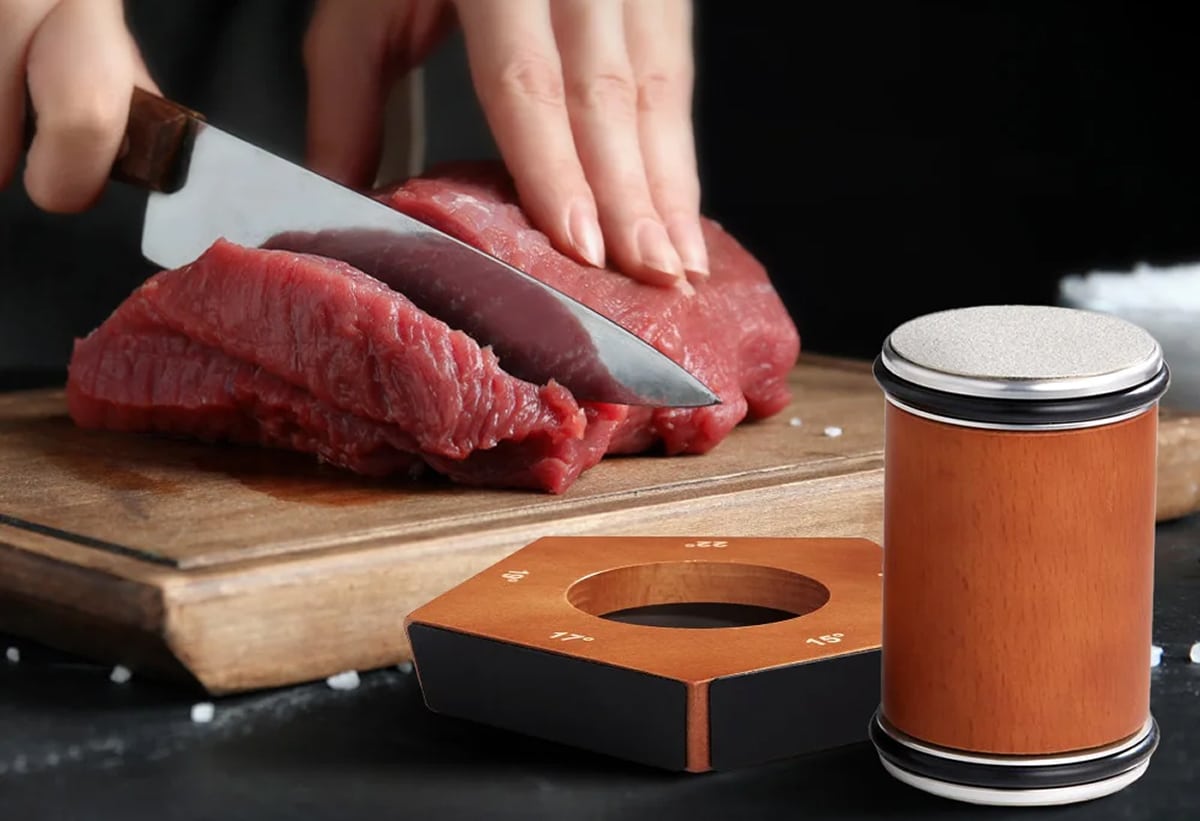
A rolling knife sharpener is an innovative culinary maintenance tool designed to restore blade bevels with consistent mechanical precision. Unlike traditional whetstones requiring complex manual wrist control, rolling sharpeners utilize a cylindrical abrasive roller guided along a fixed magnetic base.
The system relies on a dual-component design featuring a multi-angle magnetic knife block that secures the blade at an exact angle, paired with a rolling cylinder fitted with diamond or ceramic discs.
Users glide the cylinder smoothly along the cutting edge, allowing the diamond abrasives to hone the steel evenly from heel to tip. This eliminates bevel unevenness and prevents blade scratching during routine sharpening.
Modern rolling sharpeners provide a safe, mess-free alternative for maintaining expensive kitchen cutlery, delivering razor-sharp factory edges at home without requiring water tubs, electricity, or professional expertise.
© 2024 BestReviewElite. All rights reserved.
Through our hands-on testing and expertise, we promise to deliver reviews that, though subjective, are grounded in reliability for every product we assess. Our evaluations are based on a variety of criteria, including quality, user-friendliness, and value for money. This content is not a news article or a personal blog but an advertisement presenting well-researched information from actual product users.
Graphics and product images are for illustrative purposes only and may not represent actual products. While we strive to provide valuable information, we recommend readers conduct further research before making any purchasing decisions.